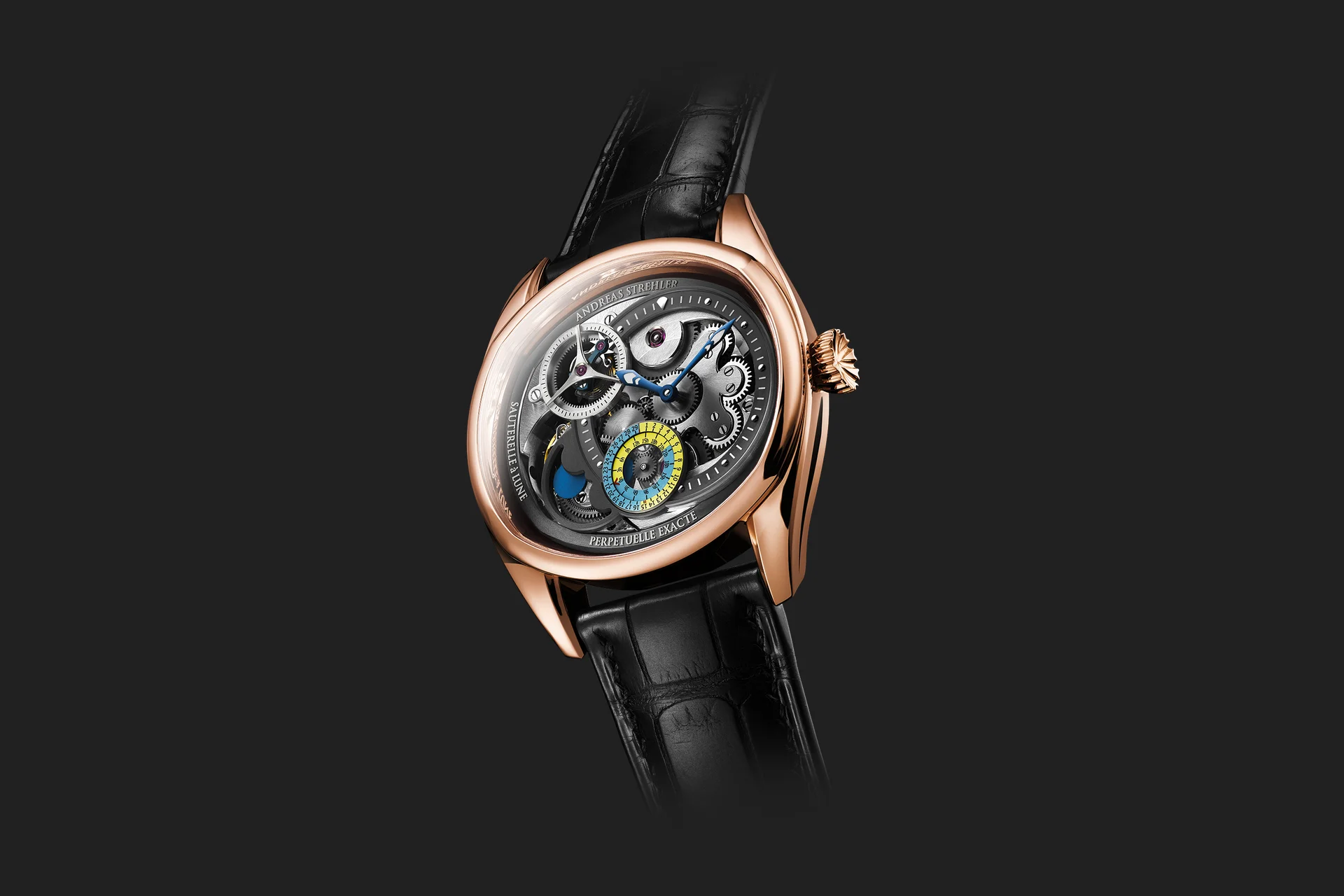
An unusually precise moonphase raises a surprisingly practical question: how accurately can its owner read it? With the Lune Exacte, Andreas Strehler brings the answer onto the dial.
There is a small red arrow at six o’clock on the Lune Exacte. Around it, blue and yellow scales divide the age of the moon into something more specific than a familiar crescent or a luminous disc. They invite the wearer to look again, and to read rather than estimate.
That distinction is the beginning of this watch’s story. A mechanism may follow a celestial cycle with extraordinary accuracy, yet leave its owner with only an approximate impression of what it knows. Strehler’s response was to bring the information within reach.
A question beyond the record
The Lune Exacte builds on the Sauterelle à lune perpétuelle, whose moonphase mechanism earned a Guinness World Records entry in 2014. The manufacturer specifies a calculated deviation of one day in two million years relative to the mean lunar cycle. Its current product page also acknowledges that the record was surpassed in 2024.
The number describes the gearing’s approximation of that cycle. It is not a promise that an assembled watch can run untouched for millions of years. Winding, servicing and correct setting remain part of owning a mechanical watch.
For Strehler, a further problem remained. A conventional pictorial moonphase does not readily tell its owner the moon’s age in days and hours. Judging the display and setting it precisely can be difficult away from the easily recognised points of new and full moon.
The Lune Exacte addresses that relationship between the mechanism and the person using it.
Reading the moon
Alongside its pictorial moonphase, the watch carries a moon-age display with a vernier scale. The red arrow gives the number of days since new moon. An inner scale provides the finer reading in three-hour increments.
The colours have a job to do. When the arrow points into the blue portion of the outer scale, the wearer reads the blue portion of the inner vernier; the yellow sections work in the same way. The aligned marks supply the hours to add to the indicated days. One of the manufacturer’s illustrations demonstrates a reading of five days and eighteen hours.
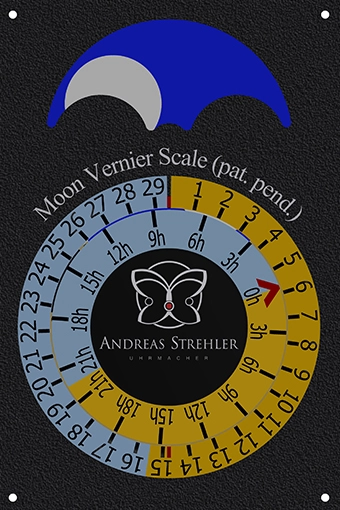
This is the useful distinction at the heart of the watch: the long-term precision of the moonphase calculation and the three-hour resolution of its setting and reading are different achievements. The second allows its owner to make more meaningful use of the first.
The blue and yellow rings also give the dial a distinctive visual centre. Their colour draws attention to a function that might otherwise remain an abstract technical claim.
An even supply of energy
The moon display shares the watch with another of Strehler’s solutions: a remontoir d’égalité, a mechanism intended to even out the delivery of energy to the escapement.
A mainspring’s output changes as it unwinds. Strehler’s arrangement places the remontoir at the fourth wheel, also called the seconds wheel. A small spring is recharged every second, then releases its stored energy in regular steps. The aim is to reduce the influence of fluctuations coming through the gear train. The mechanism also produces a seconds indication that advances in discrete one-second steps.
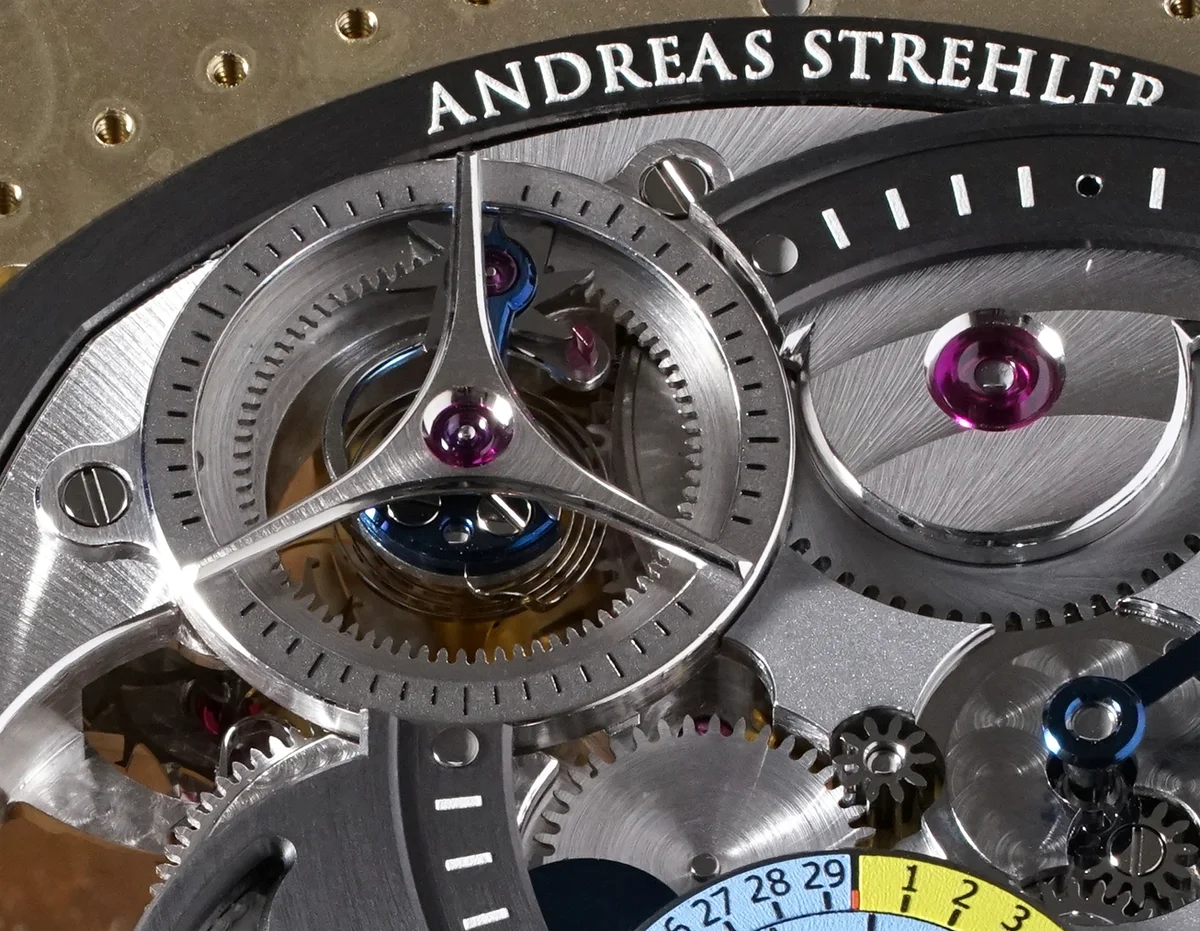
There is a connection between these two systems. One makes a slow celestial cycle easier to read; the other regulates energy on a much shorter interval. Both address a specific difficulty through the arrangement of mechanical parts.
The workshop behind the watch
Based in Sirnach, in German-speaking Switzerland, Strehler designs and manufactures movements with a small team. His work also extends to developing tools and machines used in the workshop.
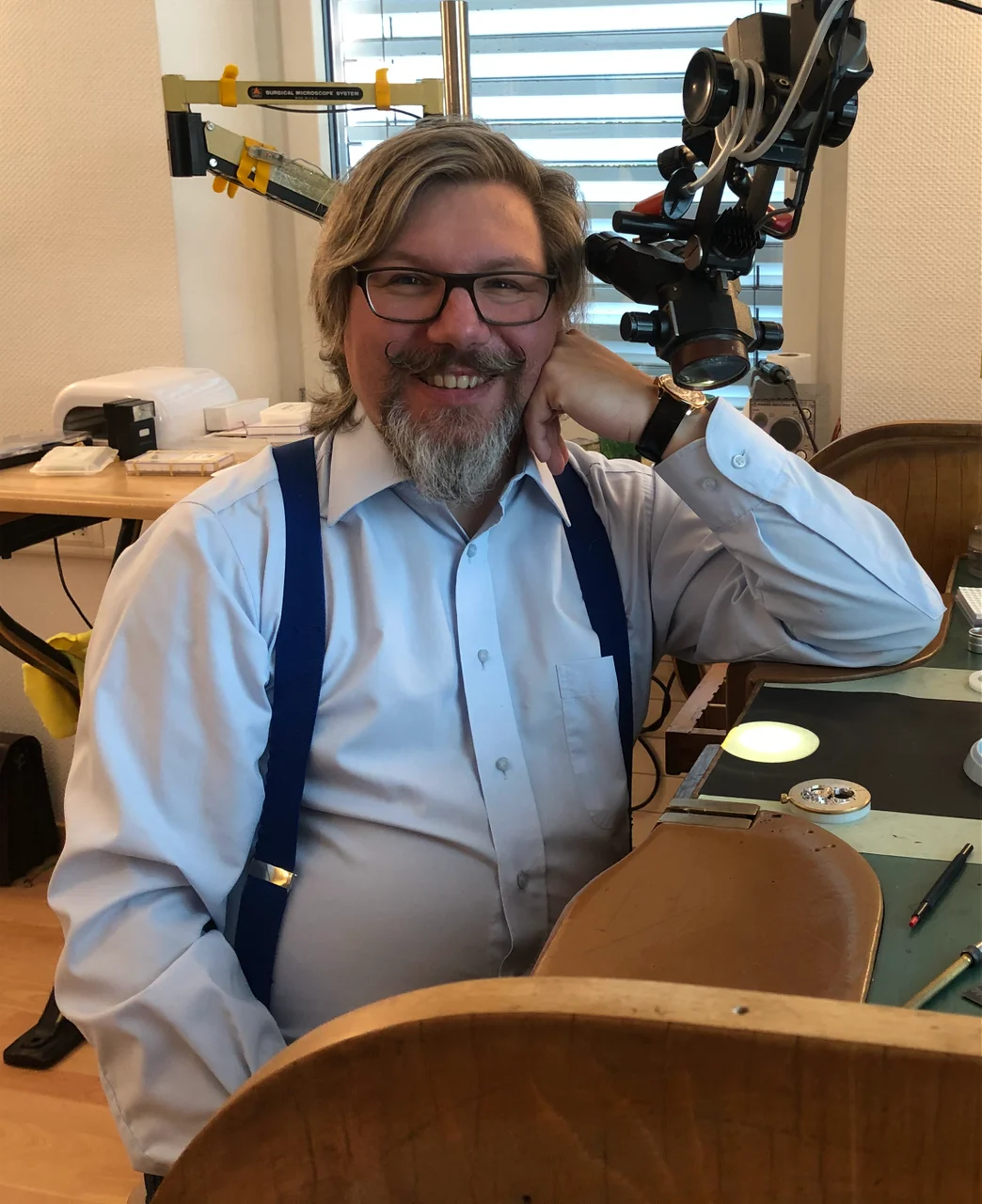
Through UhrTeil AG, founded in 2005, he develops movements and components for other watch brands. The company describes a process that encompasses feasibility studies, construction, prototypes and production. Keeping those stages close allows discoveries made during manufacture to feed back into the design.
That background gives the Lune Exacte a broader context. Its distinctive dial is supported by the knowledge needed to turn an idea into parts that can be made, assembled and brought into motion.
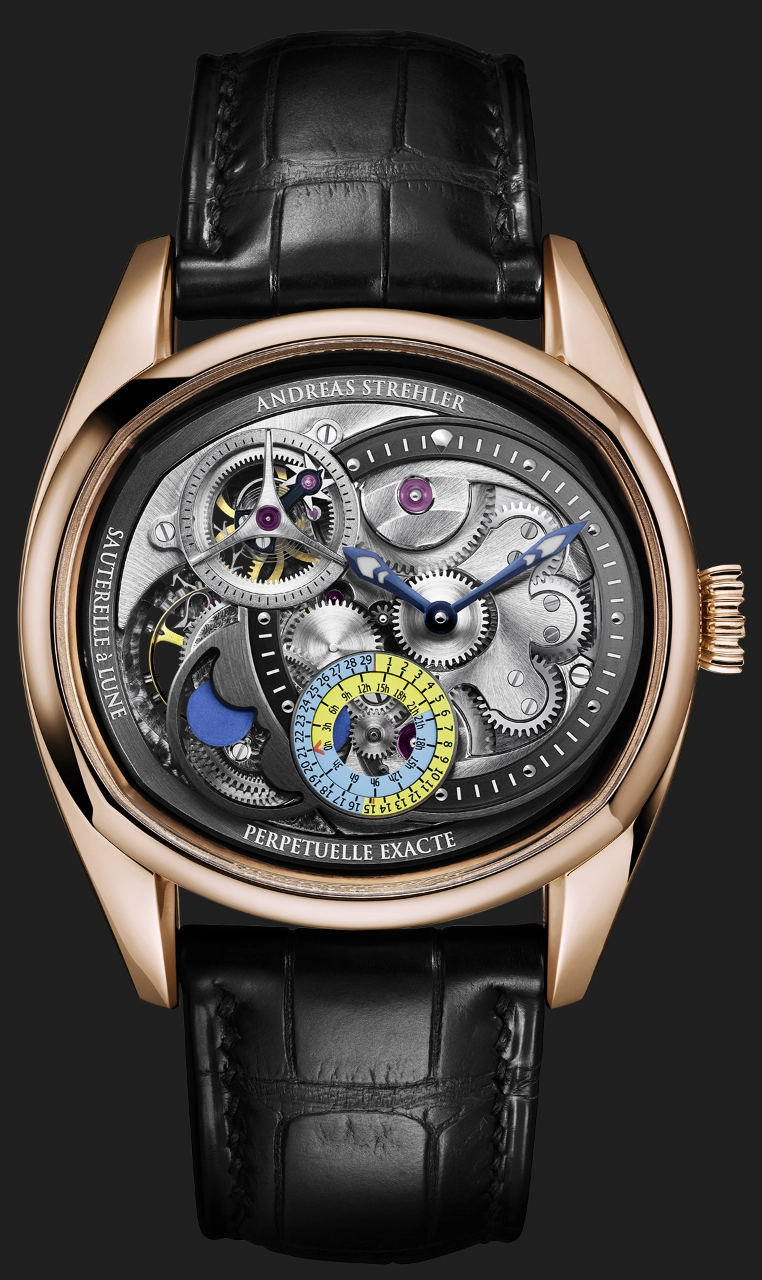
Seen from the front, the rose-gold watch in the accompanying photographs holds its blue hands, exposed mechanical elements and coloured lunar scale within a softly rounded case. From the back, the view shifts to the movement that supports the display. Together, the two views connect what the wearer reads with the machinery that makes it possible.
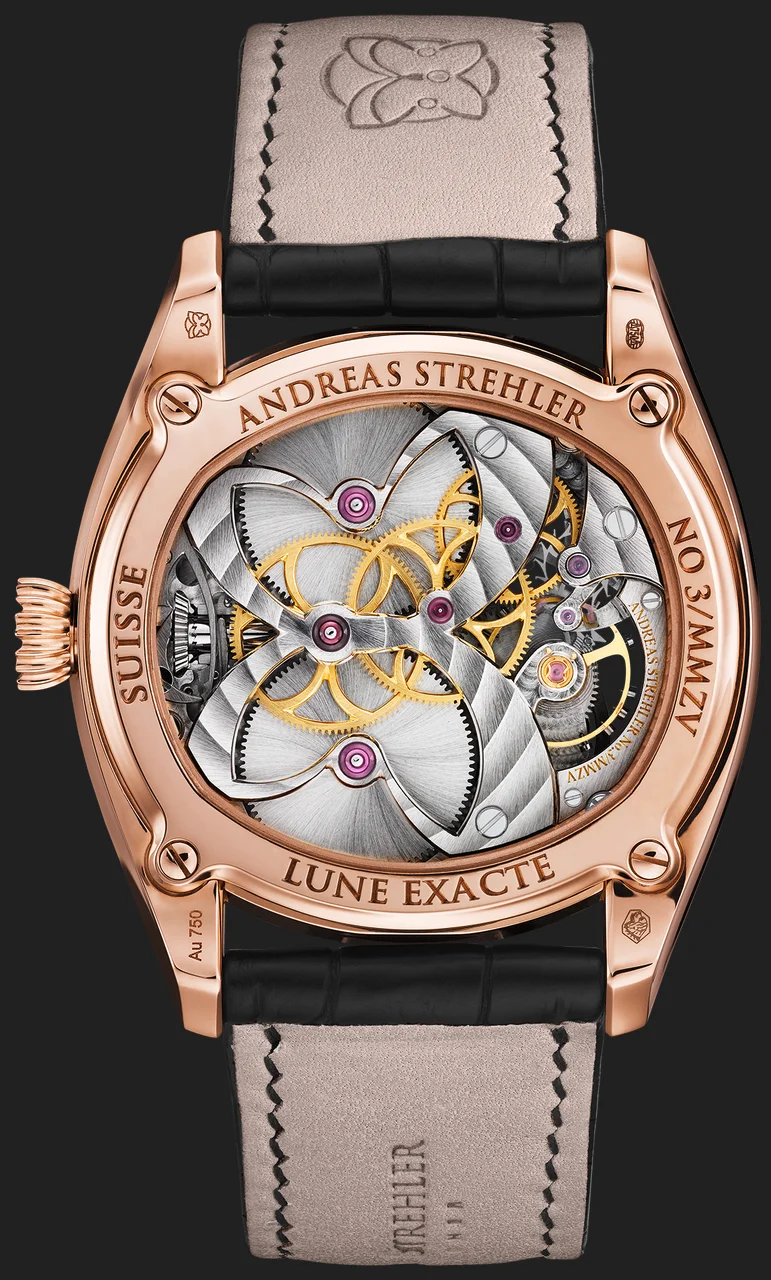
The most revealing detail remains that small red arrow. It marks a decision to carry precision all the way to the person looking at the watch. In the Lune Exacte, the achievement becomes something its owner can learn to read.
Technical details
Manufacturer specifications for the Lune Exacte; the accompanying watch photographs show the rose-gold version.
| Specification | Detail |
|---|---|
| Movement | Mechanical, manually wound |
| Indications | Hours, minutes, dead-beat seconds, moonphase and moon age |
| Moon-age reading and setting | Three-hour increments |
| Specified moonphase calculation | One day of deviation in two million years relative to the mean lunar cycle |
| Energy regulation | Remontoir d’égalité |
| Power reserve | 78 hours; two mainspring barrels |
| Frequency | 3 Hz / 21,600 vibrations per hour |
| Jewels | 25 |
| Movement components | 184 |
| Movement dimensions | 32 × 30 mm; 5.9 mm thick |
| Case dimensions | 41 × 47.2 mm; 10 mm thick |
| Case materials listed | 18-carat rose gold or platinum |
| Dial | Grey-coated silver with rotating vernier scale |
| Hands | Blue steel with Super-LumiNova |
| Strap | Black alligator leather; matching rose-gold or platinum pin buckle |
Sources and image credits
This article was researched from manufacturer documentation. It does not describe a hands-on review or a workshop visit.
- Andreas Strehler, Accurate Phase: The Lune Exacte, official press release, © 2023, supplied through the official press download area.
- Andreas Strehler — Lune Exacte: specifications and updated historical record information.
- Andreas Strehler — Engineer for the Brands / UhrTeil AG: development and manufacturing background.
- Andreas Strehler — Downloads & Press: official media source and editorial-use statement.
Images and moon-age illustration: courtesy of Andreas Strehler, from the official press materials. Portrait supplied as “AS Portrait 2020”.