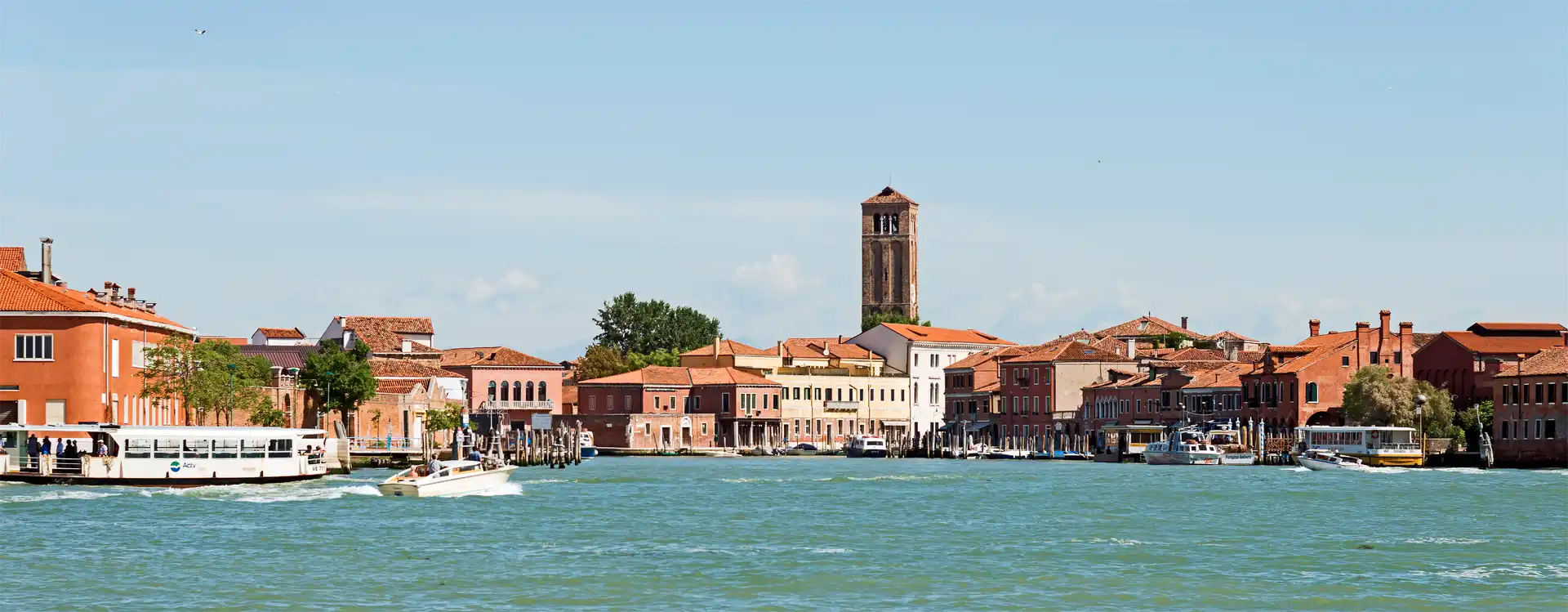
Across the Venetian Lagoon, a walk along Murano’s canals leads to a closer look at the glassmakers’ craft.
Arriving by water
From the lagoon, Murano first appears as a line of roofs, with a brick tower rising above them. Boats cross the open water; closer to shore, the buildings draw together around the entrances to the canals. The view changes again from Ponte Lungo. Looking into the Rio dei Vetrai, you can follow the water between the houses until the canal narrows in the distance. Vetrai means glassmakers. It is a telling word to find in the name of a canal, and a reminder of how closely a trade can belong to a place.
The island makes more sense if you give yourself time between stops. A short walk along the canal puts doorways and shop windows at eye level; a bridge gives you the same stretch of water from above. In a window, the light may fall through a clear vessel or pick out a fine line of colour. Those are useful details to carry with you to the glass museum. They give you something to look for when a display takes you back several centuries.
How glass took root
Glassmaking was already established on Murano when, in 1291, Venice’s Great Council ordered the removal of glass furnaces in the city, particularly around the Rialto. The decree helps explain how closely the trade came to be associated with the island.
The glass itself tells the more immediate story. By the mid-fifteenth century, Venetian glassmakers had developed cristallo, a colourless glass whose clarity recalled rock crystal. In the sixteenth century, Murano glassmakers began making filigrana, in which fine glass threads form a pattern within the vessel. The Corning Museum of Glass shows examples of both. One draws the eye through the glass; the other gives it a line to follow. Once you have noticed the difference, even a small vessel can hold your attention for a while.
What heat asks of the maker
During a glassmaking demonstration in Murano, a maker guides a long rod into the bright mouth of a furnace. The distance between the hand and the heat is striking. At one end of the tool, there is a movement small enough to make with the fingers; at the other, that movement has to remain precise where the maker cannot reach directly.
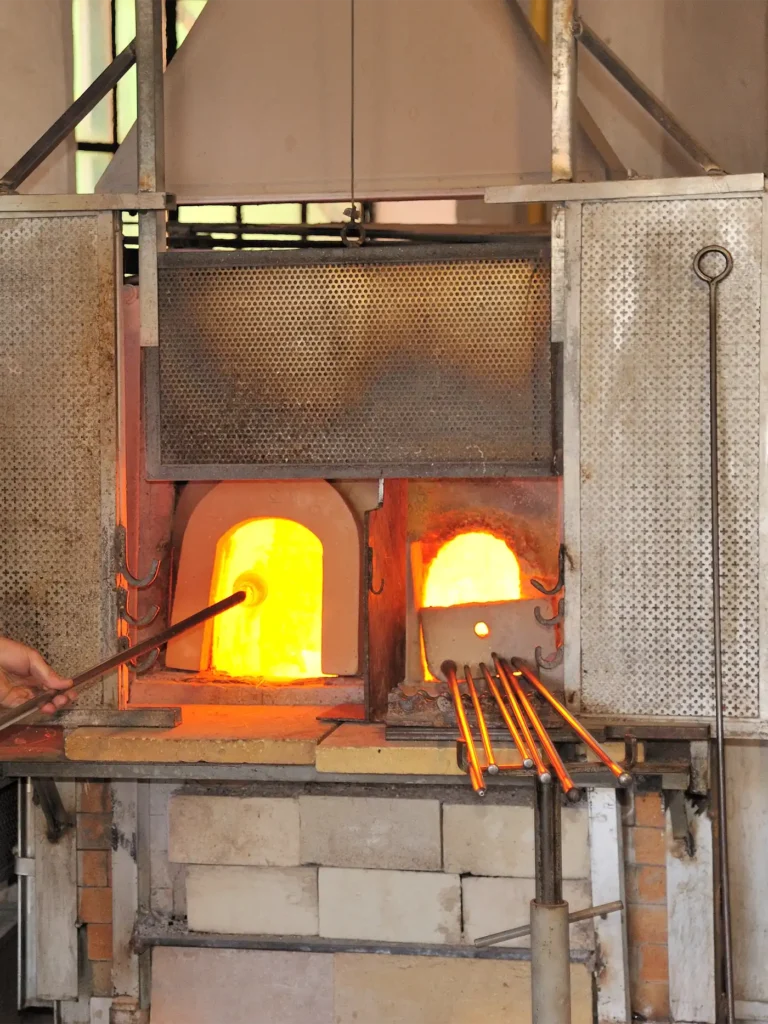

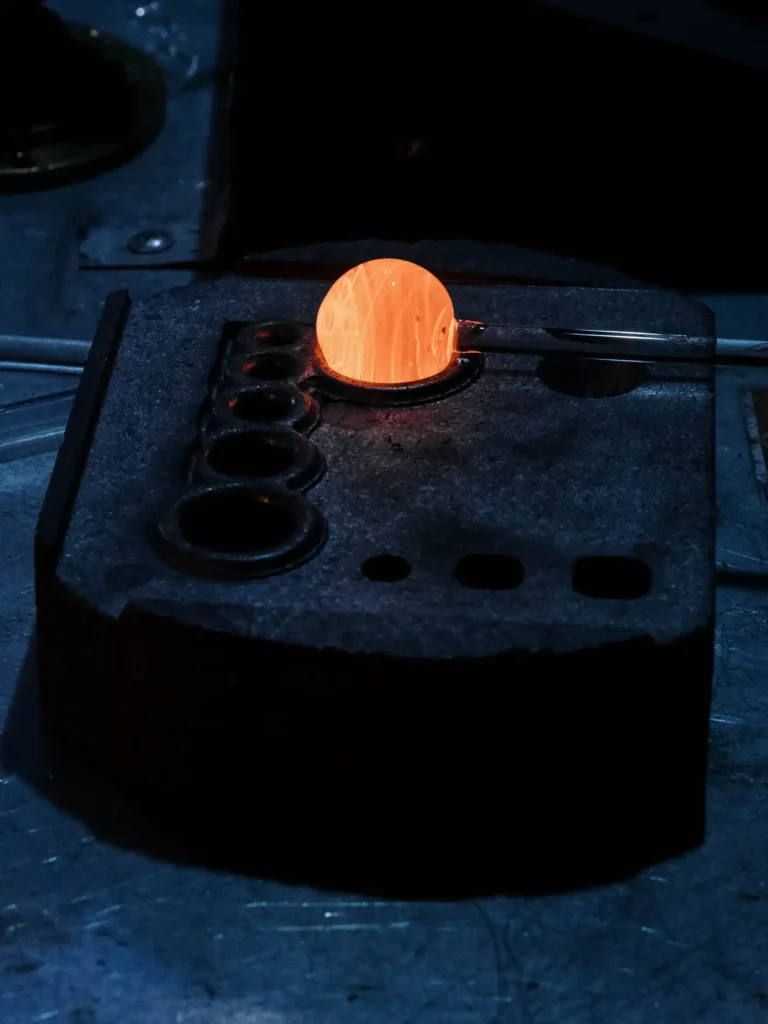
At a demonstration, watch how often the maker turns the pipe and brings the glass back to the heat. The form develops in those small intervals, while the glass is soft enough to move and firm enough to hold what has already been shaped. Even after the work leaves the furnace, controlled cooling helps relieve stress in the glass.
Where Tradition Meets Design
A glass rim can tell you a surprising amount about what happens between a drawing and a furnace. At Venini, Carlo Scarpa experimented with colour, light and traditional glassmaking techniques. In the years after the war, Fulvio Bianconi and Paolo Venini developed the Fazzoletto, a vase whose rim falls into folds like a handkerchief. The outline looks effortless; it depends on glassmakers knowing how to guide the hot material into folds of different depths.
That exchange between design and making is still visible on the island. At the 2026 edition of The Venice Glass Week, Murano glassmaker Ercole Moretti presented a plate in which small patterned pieces of glass, called murrine, spiral around an opening. Here, the pattern changes how you read the shape of the whole plate. An old technique can still give a maker a new way to draw the eye.
Looking More Closely
At the Museo del Vetro in Palazzo Giustinian, start with a detail. In a piece made with murrine, a small motif may be the cross-section of a patterned glass cane. Repeated across a surface, those slices can make a pattern that looks as though it runs through the object. Flower-like examples are known as millefiori. Once you know to look for the individual shapes, you can start to see how the surface was assembled.
The collection gives you room to make comparisons: Roman glass in the archaeological section, Venetian beads and filigree in the historical rooms, and twentieth-century pieces shaped by collaborations between designers and glassmakers. Look for the difference between a thread that runs through the glass and a motif made from the end of a cane. The museum’s notes on glassmaking techniques help put words to what you see. Palazzo Giustinian is near the Murano Museo waterbus stop; the museum keeps its visitor information online.
Seeing hot glass worked gives those finished objects another dimension. Vetreria Artistica Colleoni, on Fondamenta San Giovanni dei Battuti, offers a paid visit that includes a glassblowing demonstration. The local glassmakers’ consortium also lists workshops that receive groups by prior arrangement. Confirm with the workshop before going; an open showroom does not necessarily mean the furnace is open to visitors.
Give yourself time to walk between the museum and the workshops. From the canal, a doorway or a window can bring you back to the things you noticed indoors: how a coloured edge catches daylight, how a rim bends, how a pattern changes when seen from the side. The objects in the museum and the work still being made on the island belong to the same story. The knowledge survives partly because makers can use it to try something different.
On the way back, pause again at the canal. The houses and boats may be the same ones you saw when you arrived, but the shop windows offer a different kind of detail now: a clear stem, a thread of colour, a pattern whose edges you can begin to pick out. Murano is a place to take that second look. It is also a place that teaches you what to look for the next time you hold a piece of glass up to the light.
Featured image credit: The Canale San Giovanni in Murano, seen from the Venetian Lagoon. Photo by Didier Descouens via Wikimedia Commons, CC BY-SA 4.0. Resized and converted to WebP.
