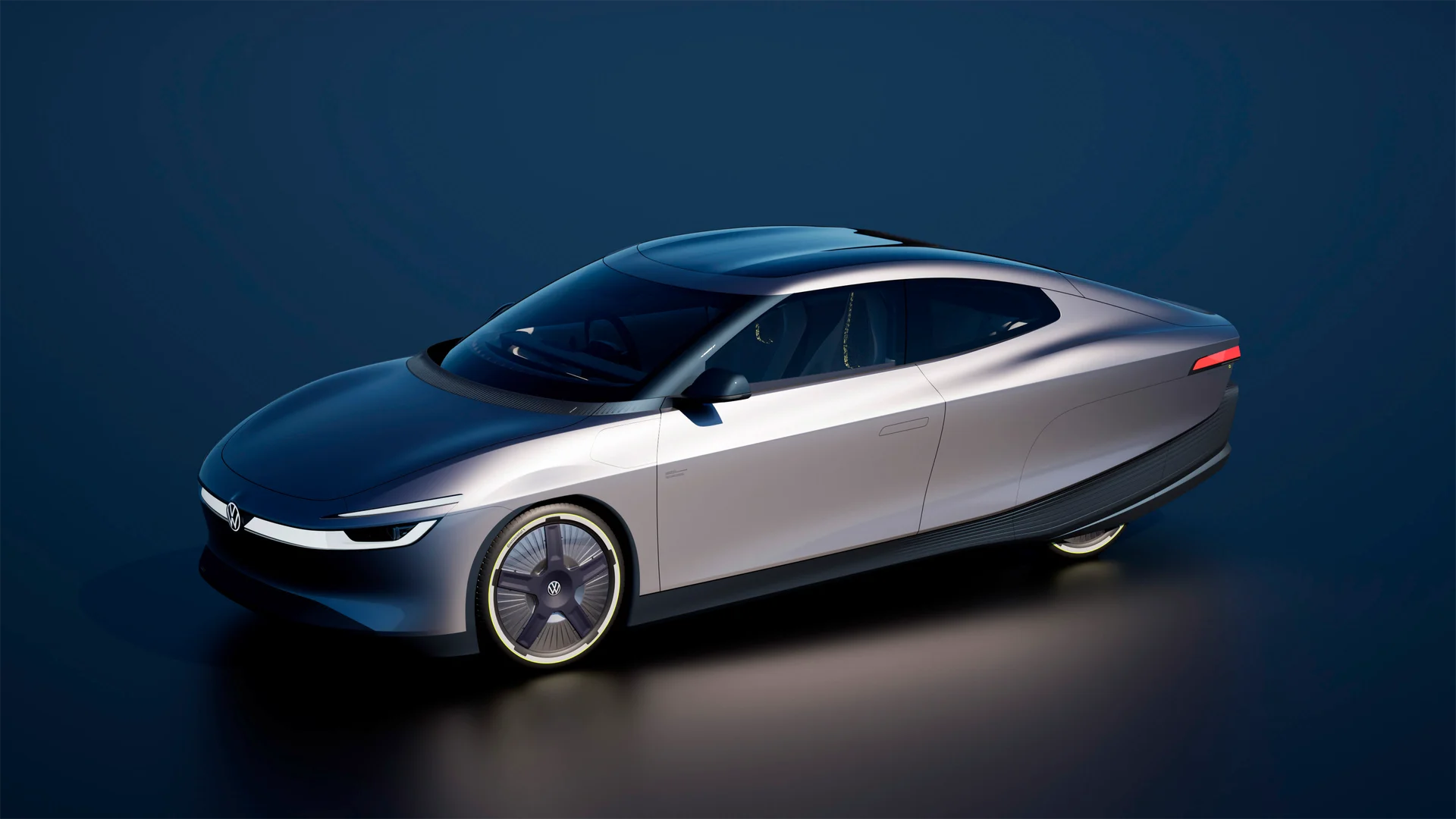
Volkswagen’s Mission Efficiency asks a deceptively simple question: how much less energy can a car use when its shape, technology and everyday details are developed around the same purpose? Behind the striking silhouette is a story of coordinated decisions—and of knowing what each number really means.
A shape with a job to do
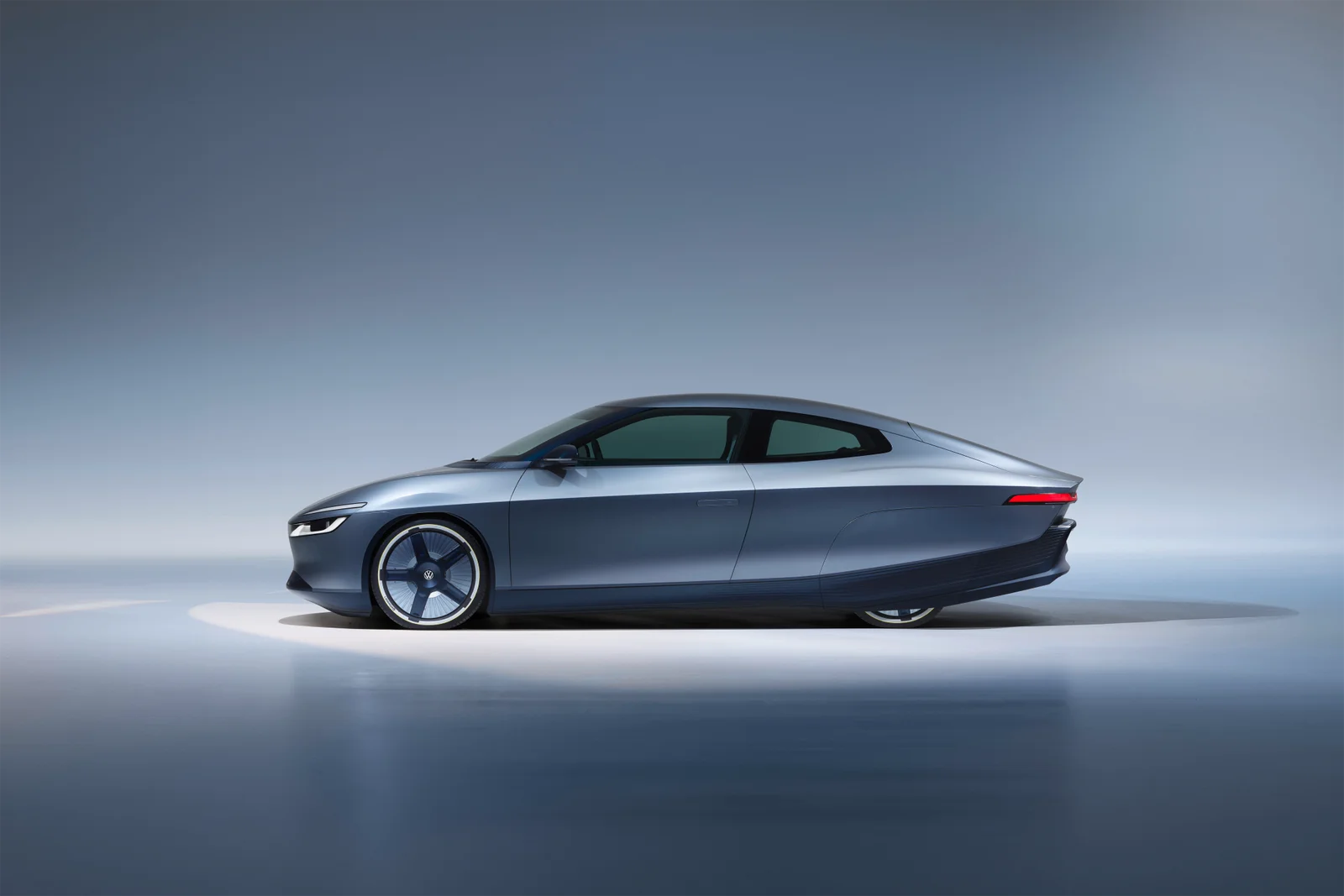
Viewed from the side, the Mission Efficiency seems to stretch almost uninterrupted from its low nose to its long tail. The rear wheels largely disappear behind the bodywork. There is little in the outline that looks incidental.
This is a concept vehicle, not a car offered for sale. Its value as a design study lies in making a technical objective visible. The Volkswagen Design sketch shows the same emphasis on a low, extended body that appears in the completed prototype. Looking between the drawing and the photographs, it is possible to follow a visual idea into a physical object.
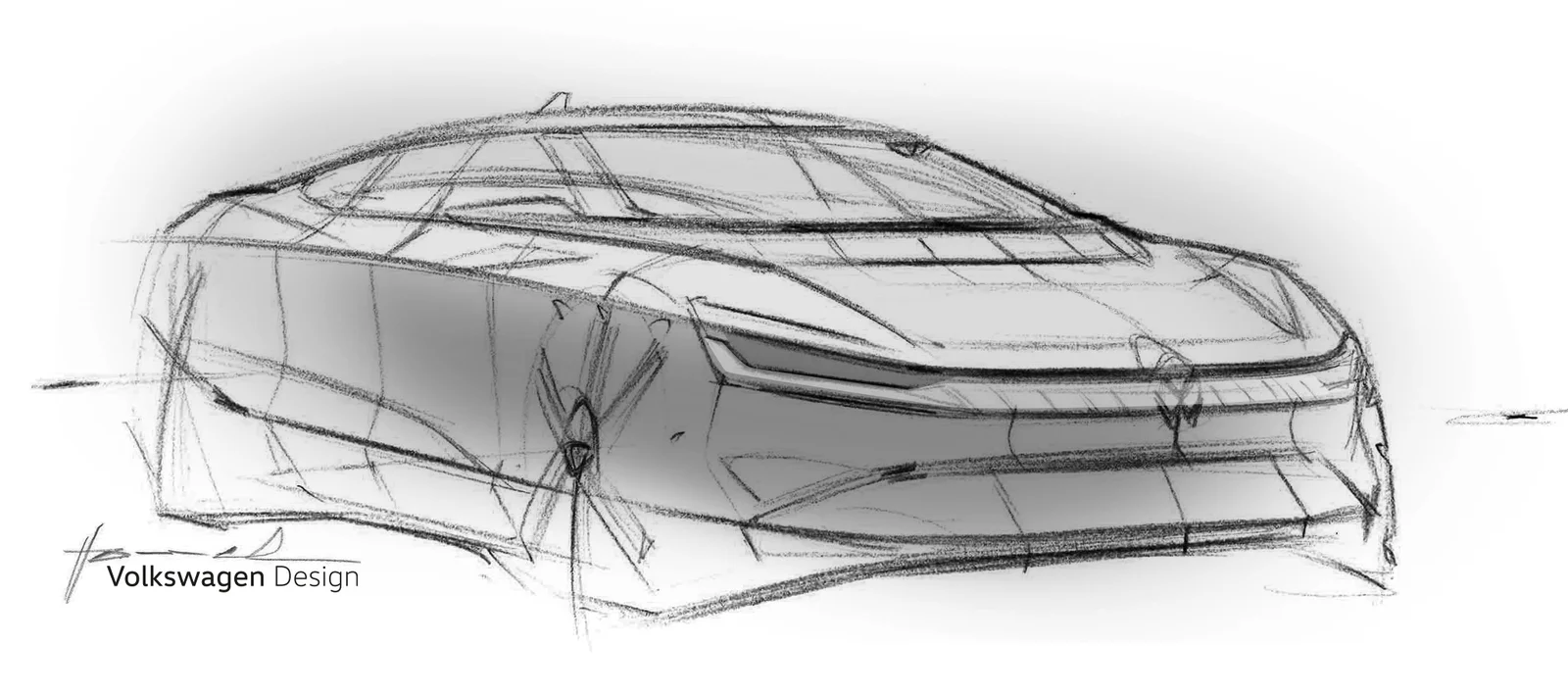
Volkswagen describes a body shaped around airflow: a narrowing tail, covered rear wheels, active cooling flaps and an extensively enclosed underside. The quoted drag coefficient is Cd 0.158. That number describes the aerodynamic character of the shape; frontal area also matters when considering the resistance the complete car encounters.
Efficiency therefore becomes a relationship between proportions and details. A long tail and a carefully controlled opening at the front belong to the same problem, even though they work at different scales.
The people connecting the decisions
The project was developed in Wolfsburg. Volkswagen credits Christoph Riechel, its head of preliminary development, with coordinating the collaboration. Design was led by Andreas Mindt, who describes the body as following aerodynamic requirements.
One revealing choice concerns the exterior mirrors. Volkswagen says calculations and wind-tunnel testing found that replacing conventional mirrors with cameras would deliver little overall efficiency benefit while increasing cost. The prototype retains mirrors.
That is a useful reminder of what engineering judgement involves. An unfamiliar solution is not automatically the most suitable one. A considered project also depends on deciding where complexity earns its place.
Familiar technology in a different body
The underlying platform is MEB+ with front-wheel drive. Its electric drive and battery draw on the production technology of the ID. Polo, rather than a wholly separate drivetrain created only for a record attempt.
This connection makes the study interesting beyond its appearance. A component’s performance is shaped by the system around it: the same technical starting point can produce different results when installed in a vehicle with different proportions and energy demands.
It does not follow that a production Volkswagen will reproduce the prototype’s consumption figures. The Mission Efficiency explores a particular combination of choices, including a body developed specifically around reducing resistance.
Reading the journey correctly
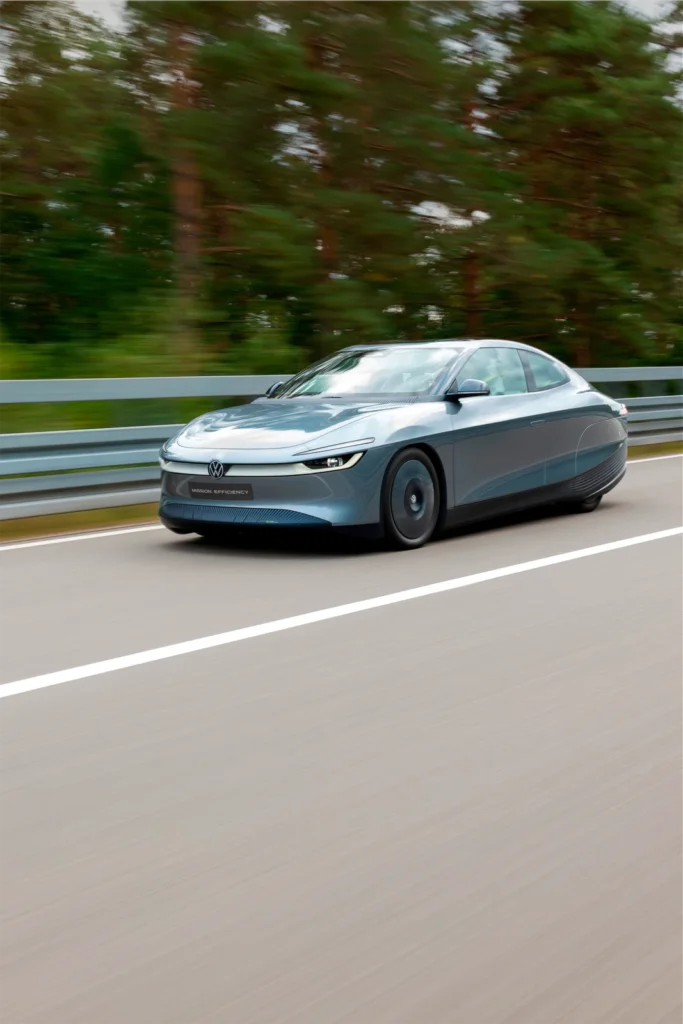
Volkswagen reports a documented 1,278.36-kilometre drive from Wolfsburg through Poznań and Olomouc to Vienna. Consumption was 6.89 kWh/100 km excluding charging losses, or 7.51 kWh/100 km including them. Average speed was 67.72 km/h, with one charging stop during the journey.
A separate idealised drive returned 6.48 kWh/100 km at a constant 68 km/h, without gradients and with auxiliary consumers such as air conditioning switched off. This is a different test from the road journey. Neither result should be presented as a promise for every driver or every route.
The distinction matters. A low figure becomes more informative when its conditions remain attached to it. The achievement is then something the reader can understand, rather than simply admire.
Small details, shared purpose
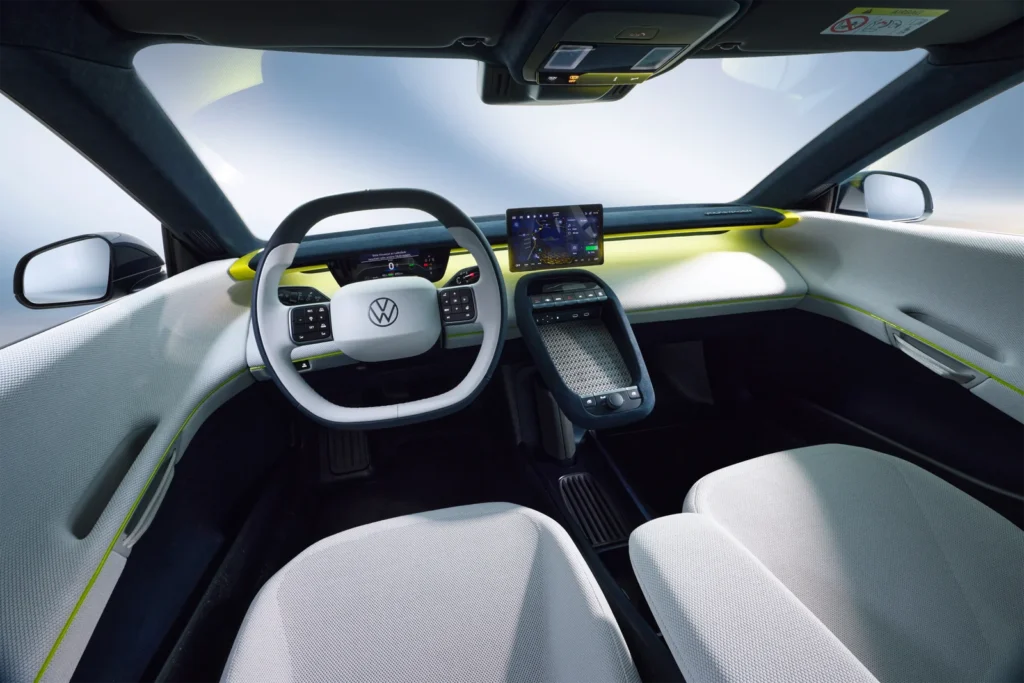
Inside, the concept uses a smartphone or tablet for infotainment instead of a permanently integrated central infotainment display. The cabin photograph gives that decision a visible form: a compact screen sits within a relatively spare dashboard.
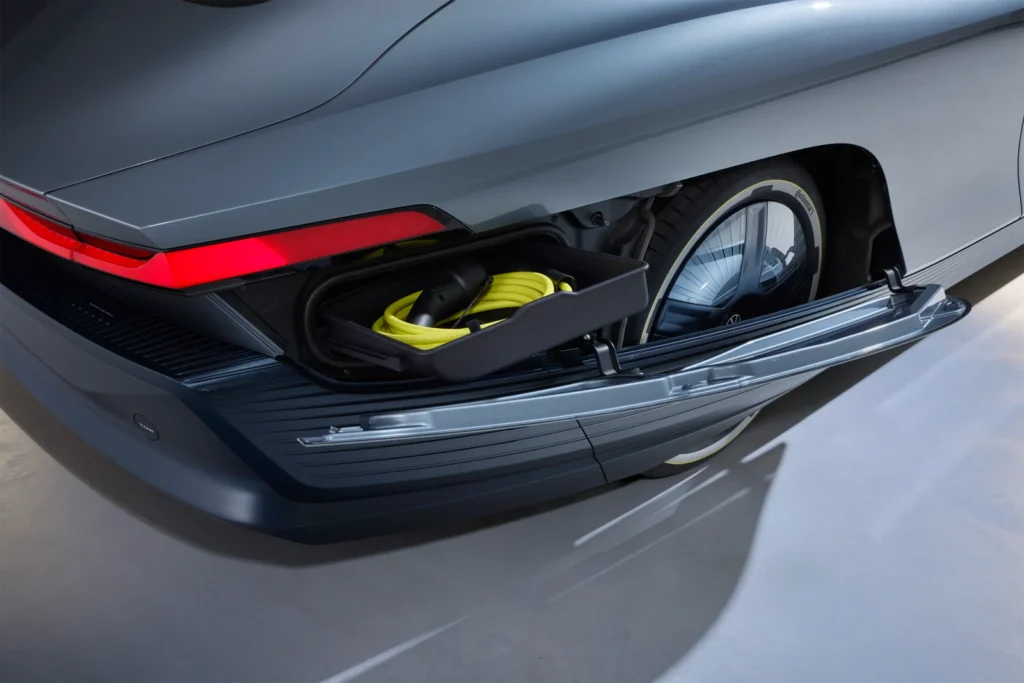
Elsewhere, the official detail photograph reveals a pull-out storage compartment behind the rear wheel cover, holding a charging cable. It is an appealing meeting of packaging and use: space inside the body becomes somewhere for an object that travels with the car.
The vehicle is arranged as a 2+2-seater, with the rear seats intended for occupants up to approximately 1.60 metres tall. Its practical ambitions come with clear limits. Those limits are part of understanding the design, just as much as its capabilities.
Quality through attention
The Mission Efficiency’s most useful story reaches beyond the language of records. It shows a way of working in which the outline of a body, a component choice and a storage compartment can answer the same brief.
The result remains an experiment. Yet experiments can make the work behind a product easier to see. Here, quality appears in the effort to understand where energy goes—and in the judgement required to use less of it.
Technical details at a glance
Manufacturer-published figures for the concept vehicle.
| Detail | Volkswagen Mission Efficiency |
|---|---|
| Status | Concept vehicle. Not for sale. |
| Platform / drive | MEB+ / front-wheel drive |
| Electric motor | APP290 permanently excited synchronous motor |
| Power / maximum torque | 99 kW (135 PS) / 264 Nm |
| Battery capacity | 54.9 kWh net |
| Maximum DC charging power | 105 kW |
| Drag coefficient / frontal area | Cd 0.158 / 2.08 m² |
| Manufacturer-published WLTP driving consumption | 8.4 kWh/100 km |
| Documented road-drive consumption | 6.89 kWh/100 km excluding charging losses; 7.51 including them |
| Idealised-drive consumption | 6.48 kWh/100 km; separate controlled conditions |
| Length × width × height | 4,775 × 1,744 × 1,392 mm; width excludes mirrors |
| Wheelbase | 2,700 mm |
| Seating / luggage capacity | 2+2 / 481 litres |
| Top speed / 0–100 km/h | 160 km/h / 9.0 seconds |
The consumption figures above describe different measurement contexts and should not be treated as interchangeable. Record-drive results are Volkswagen-reported figures, not an independent Nacré Strata road test.
Sources and images
This feature is based on Volkswagen’s published technical information and official press imagery. Nacré Strata has not driven the vehicle. References to record performance reflect Volkswagen’s reporting.
- Volkswagen Newsroom — The new Mission Efficiency: World premiere
- Volkswagen Newsroom — At a glance: Mission Efficiency
- Volkswagen — Mission Efficiency concept overview
- Volkswagen Newsroom — Mission Efficiency image album
Photography and design sketch: © Volkswagen AG. Supplied through Volkswagen Newsroom for editorial use. Concept vehicle. Not for sale.